
A chronically coughing cat may well be asthmatic, but infectious bronchopneumonia, Mycoplasma, lungworm, heartworm-associated respiratory disease, and airway neoplasia all sit close enough on history and radiographs that a bronchial pattern plus a steroid response does not close the case. Most of these cats arrive with a “hairball” history, which usually means the cough has been present far longer than the client realized and the chronicity has blurred whatever classic distinctions once existed. Empirical corticosteroids will quiet a true asthmatic, temporarily flatter a lungworm case, and work against the patient whose signs are infectious or cardiogenic in origin. The differentiation is worth pursuing early, because confirmed feline asthma is a genuinely manageable disease, while every one of its mimics carries a different treatment path.
When a feline chronic cough stalls at the bronchial-pattern stage, VESPECON gives general practices across the US a specialist to think through the case with. Our radiograph and CT interpretation puts specialist eyes on the thoracic study you have already taken, and our cardiology consultants can layer in an echocardiographic read when cardiogenic disease refuses to leave the differential list. We stay on the case as ongoing concierge support, from ranking the differentials to deciding whether airway sampling is justified before another empirical trial. If a coughing cat on your schedule has outlived its working diagnosis, schedule a phone consultation and put a specialist on the problem.
The Coughing Cat, Condensed
- A bronchial pattern with a partial steroid response points toward feline asthma, but it doesn’t rule out infection, lungworm, heartworm-associated disease, cardiogenic signs, or airway neoplasia.
- Persistent coughing, wheezing, and a rising resting respiratory rate call for a workup, while open-mouth breathing, pale or blue gums, and a crouched, neck-extended posture are a crisis that needs same-day stabilization.
- Confirming asthma before the next empirical trial protects the cat, because reflexive steroid courses can cost each mimic its best window for targeted treatment, and actively worsen the fungal, protozoal, and infectious ones.
- When a feline cough stalls at the bronchial-pattern stage, a specialist read on the thoracic study and a second set of eyes on the differentials keep the case moving.
What Is Feline Asthma, and Why Doesn’t a Bronchial Pattern Close the Case?
Feline asthma is a chronic inflammatory disease of the lower airways, in which the immune system overreacts to inhaled allergens like dust, pollen, cleaning products, or smoke and triggers swelling, mucus, and narrowed breathing passages. The bronchial pattern that follows is real, but it’s a shared endpoint that several other diseases reach by different roads.
Signs can wax and wane with the seasons, tracking whatever the cat is breathing that month, which is one reason a tidy history is so hard to pin down. Some cats also carry an overlapping lower-airway condition such as chronic bronchitis, which produces the same cough and labored breathing and often has to be untangled from asthma before a treatment plan is set.
For the cases that stall at a bronchial pattern and a partial steroid response, our board-certified clinical advisors in internal medicine can help rank the airway differentials and decide how hard to push before the next empirical trial.
Which Clinical Signs Point to Asthma, and Which Signal a Crisis?
Chronic asthma shows up as an intermittent dry cough, wheezing, exercise intolerance, and a resting respiratory rate that creeps above the low thirties even between episodes. A true crisis looks and moves differently, and it calls for same-day intervention rather than a recheck next week.
The hunched, retching posture of coughing up a hairball looks nearly identical to an asthma cough, so a cat that keeps working on a hairball but never brings one up may be coughing from inflamed airways instead. Cats are built to conceal weakness, so the first hints read as quirks: a little less interest in the evening play session, a breath that only looks fast if someone stops to count it. Months can pass before anyone connects those quirks into a pattern worth investigating.
Some changes can’t wait. Pale or bluish gums, a sudden shift in breathing rhythm, or a cat that crouches with its neck extended and refuses to lie down all point to respiratory distress. A cat in that state needs oxygen and stabilization first; the diagnostic conversation can wait until they’re breathing easily again.
What Else Mimics Feline Asthma?
The differential list for a coughing or tachypneic cat spans infectious, parasitic, cardiac, structural, and pleural space disease, and asthma itself is only one branch of the broader family of feline lower airway disease. Working a structured diagnostic approach to the coughing cat beats another empirical trial, because each mimic below has a targeted treatment, and several get actively worse on the steroids that soothe a true asthmatic. The full catalog of feline lung and airway disorders is long, but the mimics that matter cluster into three groups.
Infectious Causes, From Common to Reportable
Upper respiratory infections usually begin with sneezing and nasal discharge, but the viral and bacterial agents behind feline respiratory infections can extend into the lower airways and turn what looked like a head cold into bronchopneumonia. Mycoplasma in particular is willing to smolder in the lower airways and produce a cough that eases, briefly, on steroids.
The less common infectious mimics are the ones empirical therapy punishes hardest. Fungal pneumonia from organisms like Histoplasma or Cryptococcus, inhaled from soil and droppings, produces coughing and weight loss that steroids make dramatically worse by suppressing the immune response holding the organism in check. Toxoplasmosis can do the same as a protozoal pneumonia, flaring under immunosuppression in exactly the patient being treated for presumed asthma. And in cats that hunt rodents in endemic regions, pneumonic plague belongs on the list: a febrile, rapidly declining cat with respiratory signs and swollen lymph nodes is a reportable disease and a genuine zoonotic risk to the household and the veterinary team. None of these are everyday diagnoses, but all of them are why a steroid-responsive cough that keeps relapsing deserves cytology, culture, and a hard look at the travel and lifestyle history rather than a fourth steroid course.
Parasites, Heartworm, and the Heart Itself
Lungworm rides in on an outdoor or hunting history and will partially improve on steroids, which is exactly how it hides; a Baermann fecal test finds the larvae. Heartworm-associated respiratory disease produces asthma-like signs in endemic areas even at low worm burdens, and needs paired antigen and antibody testing to expose. Heart disease can drive the same coughing and effortful breathing, which is why cardiac function has to be ruled out before those signs get attributed to asthma. When a cardiac cause keeps hanging over the case, our tele-cardiology and tele-radiology reads let you layer a specialist interpretation onto the thoracic films and an echocardiographic read onto the workup.
Structural and Pleural Space Disease
Years of unchecked lower airway inflammation or repeated infection can leave a cat with bronchiectasis, permanently dilated, floppy airways that pool mucus and reinfect themselves; it’s the end-stage structural change that turns a treatable airway disease into a management problem, and CT characterizes it far better than plain films. The pleural space produces its own mimics: chylothorax and pyothorax fill the chest with lymphatic fluid or pus, restricting lung expansion so the cat presents with rapid, shallow breathing and muffled heart and lung sounds more than a true cough. Radiographs flag the effusion, and thoracocentesis is both the diagnostic and the first treatment. Airway neoplasia rounds out the group in older cats, showing a focal or mass pattern and signs that progress no matter what gets prescribed.
| Condition | What sets it apart from asthma |
| Upper respiratory infection or bronchopneumonia | Sneezing, nasal or ocular discharge, sometimes fever; cytology and culture point to infection |
| Mycoplasma or bacterial lower-airway disease | Neutrophilic airway cytology and a response to targeted antibiotics rather than steroids |
| Fungal pneumonia | Weight loss and systemic signs, worsens on steroids; travel or soil exposure history, fungal testing |
| Toxoplasmosis | Protozoal pneumonia that flares under immunosuppression; serology supports it |
| Pneumonic plague | Hunting cats in endemic regions; fever, lymphadenopathy, rapid decline; reportable and zoonotic |
| Lungworm | An outdoor or hunting history, with larvae found on a Baermann fecal test |
| Heartworm-associated respiratory disease | Exposure in an endemic area, confirmed on antigen and antibody testing |
| Cardiogenic disease | A murmur or gallop, with structural change seen on an echocardiographic read |
| Bronchiectasis | Permanently dilated airways after chronic inflammation or infection; best characterized on CT |
| Chylothorax or pyothorax | Restrictive, shallow breathing with muffled sounds; effusion on films, thoracocentesis confirms |
| Airway neoplasia | An older cat, a focal or mass pattern on films, and signs that progress despite therapy |
| Gastrointestinal or hairball cause | Retching that produces nothing, with clear thoracic radiographs |
How Is Feline Asthma Diagnosed?
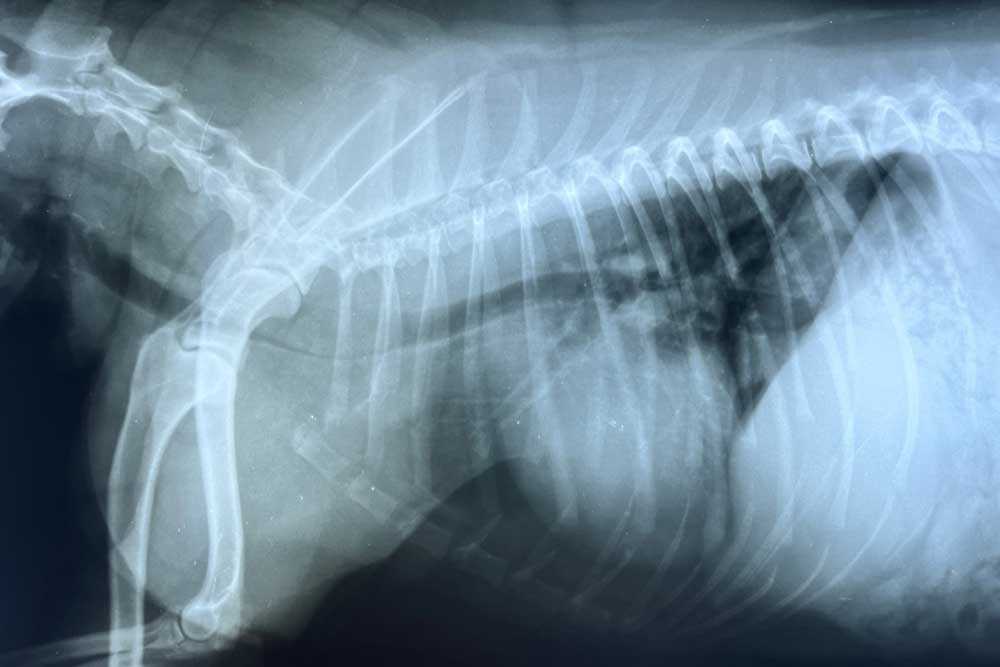
Diagnosis is mostly a process of exclusion built on thoracic radiographs, which often show the classic bronchial or doughnut-shaped pattern, plus bloodwork that may flag eosinophilia or systemic inflammation.
A bronchial pattern is suggestive, not definitive; our radiograph interpretation often shifts how much confidence the working diagnosis deserves.
From there, the workup follows the clues. Complex or refractory cases may need airway sampling, where a bronchoalveolar lavage or tracheal wash separates eosinophilic inflammation from an infectious, neutrophilic one. When cardiogenic disease is still on the table, an ultrasound of the heart assesses function directly.
Families can move the diagnosis along from home, too. Coaching clients on recording a resting respiratory rate while the cat sleeps builds a baseline that makes it far easier to catch when breathing starts trending in the wrong direction, and a phone video of an episode, captured when it’s safe to do so, is often worth more than any description.
How Is Feline Asthma Treated?
Treatment works on two targets at once: corticosteroids calm the airway inflammation, and bronchodilators open the constricted airways back up. Most stable cats settle onto a maintenance plan scaled to how often and how hard they flare.
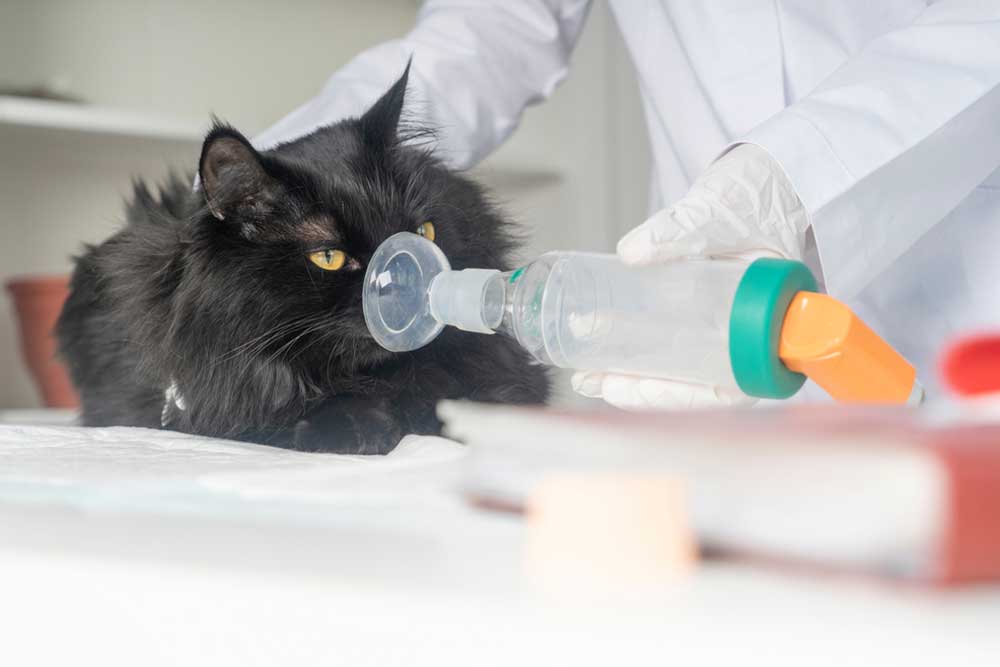
Route matters as much as drug choice. Inhaled therapy is often the preferred long-term choice because it delivers medication straight to the lungs with fewer whole-body side effects, given through a feline spacer like the AeroKat chamber fitted with a small face mask.
For cats whose asthma is clearly allergen-driven, allergy testing, immunotherapy, and antihistamines can take some pressure off the inflammation before it starts. No two asthmatics flare the same way, so we map out the plan case by case with you; that back-and-forth is what our specialty consultations are built for.
| Treatment class | What it does | Route and notes |
| Corticosteroids | Calm the underlying airway inflammation | Oral, injectable, or inhaled |
| Bronchodilators | Relax constricted airways to ease the breath | Inhaled or oral; used for rescue and maintenance |
| Inhaled combination therapy | Deliver medication straight to the lung | Feline spacer and mask; fewer whole-body effects |
| Allergy-directed options | Address the allergic driver behind the inflammation | Allergy testing, immunotherapy, or antihistamines in selected cats |
How Should an Acute Asthma Flare Be Managed at Home?
During a flare, the goal is to keep the cat calm, because panic and struggling tighten the airways even further. Families should move the cat somewhere quiet and give the prescribed rescue inhaler if the cat tolerates the mask. What happens over the next few minutes decides whether this stays a home event or becomes an emergency run.
- Keep rescue medication within reach: A prescribed bronchodilator inhaler and spacer should live somewhere everyone in the household can find in seconds.
- Have a transport plan ready: A carrier left out and open, plus the address of the nearest emergency hospital, saves minutes that matter.
- Know the red flags: Open-mouth breathing that doesn’t ease, gums turning pale or blue, or collapse means leaving for care now, not waiting it out.
- Cut the stress: Skip the extra handling and the errands, since anything that makes an already-struggling cat fight harder only deepens the crisis.
A crisis is rarely the moment to work a case alone. Our teleconsulting stays available around the clock, so a specialist can be on the line while you stabilize the patient and decide on the next move.
Which Environmental Triggers Can Be Reduced?
Medication only carries a cat so far while the trigger stays in the air at home, so environmental control does a real share of the work, and trimming those airborne exposures often lets the maintenance drug dose settle lower than it otherwise would.
The practical wins are small and cumulative: cut back on aerosols and strong fragrances, change HVAC filters on schedule, vacuum often, and run an air purifier in the rooms the cat uses most. The litter box is its own project. Switching to a low-dust litter cuts the fine particles that puff into the air every time a cat digs, one of the most direct ways to lower the irritant load an asthmatic cat breathes in each day.
Weight belongs in the same conversation. Excess weight feeds the same inflammation that drives asthma and presses on the chest so the lungs can’t fully expand, which is why weight control belongs inside a respiratory care plan rather than beside it.
Frequently Asked Questions About Feline Asthma
Can feline asthma be cured, or is it a lifelong condition?
Feline asthma is a chronic disease, so the honest answer is that it’s controlled rather than cured. The airway inflammation can be quieted and flares made rare with a consistent maintenance plan, environmental control, and monitoring, and most cats diagnosed early live full, comfortable lives.
Does a good response to steroids confirm the diagnosis?
A steroid response is supportive but not proof, because corticosteroids blunt inflammation across many diseases at once. That’s why a response to empirical therapy should raise confidence, not close the file. Thoracic imaging, targeted bloodwork, and in some cats airway sampling are what move asthma from a working guess to a confirmed diagnosis.
How can a family tell an asthma cough from a hairball?
The two look almost identical from across the room, since both involve a hunched, retching posture. The tell is what comes up: a hairball episode usually produces something and then resolves, while an asthma cough is dry, recurrent, and brings up nothing. Capturing an episode on video and counting the resting respiratory rate afterward gives you something concrete to work from.
When the Cough Outlives the Working Diagnosis
The hard part is rarely the asthma itself; it’s making sure the cough on the schedule is actually asthma and not one of its mimics. When a case stalls at the bronchial-pattern stage, reach out and the VESPECON team will help re-rank the differentials. We stay on the case as ongoing case collaboration from the first read through the maintenance plan.



Leave A Comment